All-Star Cheer Coach Training: Your Coaches Know Cheerleading, But Do They Know How to Teach It?
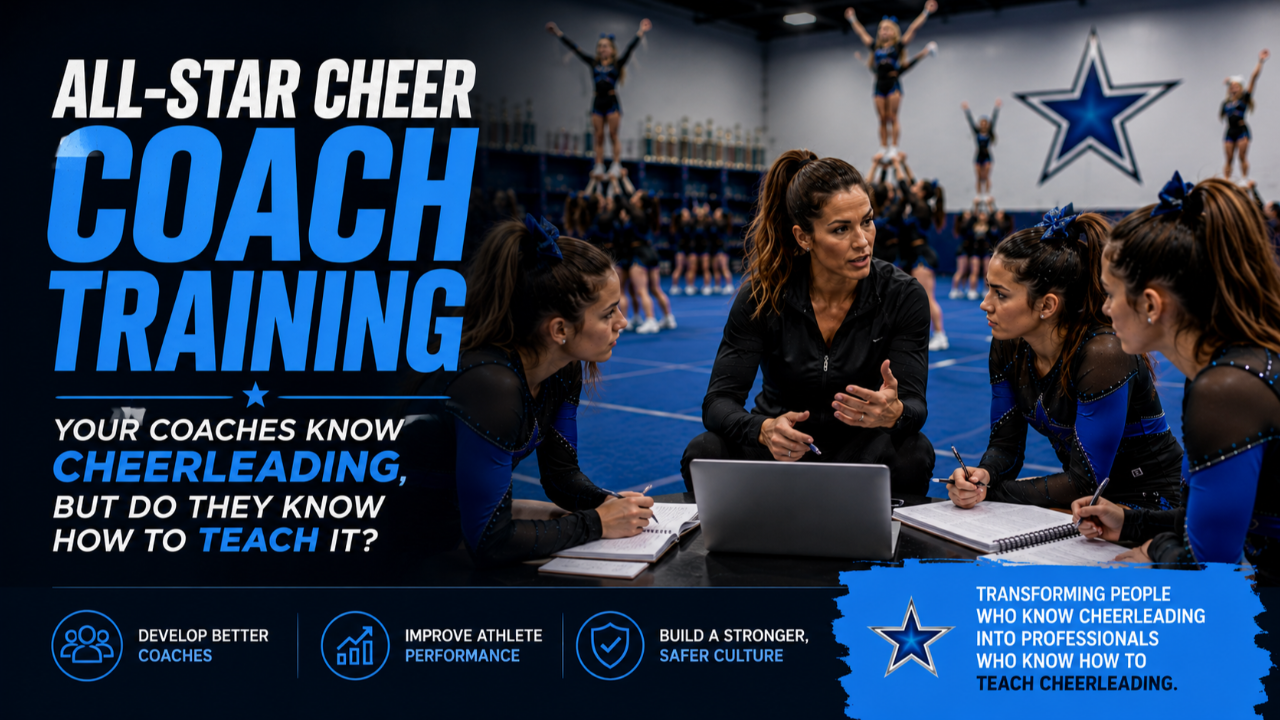
One of the biggest mistakes an All-Star Cheer gym can make is assuming that someone who knows cheerleading automatically knows how to coach and teach cheerleading.
They are not the same skill.
A new coach may have competed for ten years. They may understand tumbling, stunting, jumps, pyramids, choreography, routines, and competition. They may have been an exceptional athlete and understand exactly what a skill should look and feel like.
Then you put them in front of a group of athletes and discover something important:
Knowing how to perform cheerleading skills and knowing how to teach another athlete to perform them are completely different competencies.
That distinction should fundamentally change the way All-Star Cheer gym owners approach cheer coach training and staff development.
If you want better coaches, you need more than technical knowledge, credentials, and experience.
You need a system for developing coaches as teachers.
Why All-Star Cheer Coach Training Needs to Go Beyond Technical Skills
All-Star Cheer gyms have become incredibly sophisticated at developing athletes.
Think about the systems inside your gym.
Athletes have skill progressions.
Evaluations.
Team placements.
Practice schedules.
Private lessons.
Drills.
Corrections.
Performance goals.
Competition preparation.
Strength and conditioning.
Expectations for advancement.
When an athlete struggles, a coach identifies the problem and develops a plan for improvement.
Now apply the same thinking to your coaching staff.
What is your development pathway for turning an inexperienced coach into an excellent coach?
For many cheer gyms, the answer is surprisingly informal.
A new coach shadows an experienced coach.
They help with classes.
They learn the gym's terminology.
They observe practices.
Someone explains the basic expectations.
Eventually, they are given athletes to coach.
From there, much of their cheerleading coach training happens through experience.
Experience is valuable.
But experience alone is not a staff-development system.
A coach can spend five years coaching without necessarily spending five years deliberately becoming a better teacher.
"Watch Another Coach" Is Not a Complete Cheer Coach Training Program
One of the most common approaches to developing new cheer coaches is modeling.
A new coach watches an experienced coach and attempts to duplicate what that person does.
Observation can be extremely valuable.
But observation alone has an important limitation.
The developing coach sees what the experienced coach does.
They may not understand why the coach does it.
Why did the coach give that particular correction?
Why did they temporarily ignore another technical issue?
Why did they demonstrate instead of explaining?
Why did they change the drill?
Why did they allow another attempt before giving additional feedback?
Why did they ask the athlete a question instead of simply providing the answer?
Why did they stop a progression?
Why did they simplify the task?
Why did they change the way they explained the same concept to a different athlete?
Experienced coaches can make hundreds of small instructional decisions during a single practice.
Over time, many of those decisions become almost automatic.
A developing coach needs more than the opportunity to observe those decisions.
They need to learn how to make those decisions themselves.
That is where structured All-Star Cheer coach development becomes important.
Great Cheer Coaches Need More Than Cheerleading Knowledge
Technical competence is essential.
Cheer coaches should understand the skills they are responsible for teaching, remain within their qualifications, follow applicable rules and standards, and understand the safety considerations associated with their responsibilities.
But technical knowledge is only one component of professional coaching.
An effective cheer coach also needs to understand how to:
Observe athlete performance.
Communicate clearly.
Structure instruction.
Provide useful feedback.
Prioritize corrections.
Manage practice time.
Check for athlete understanding.
Adapt instruction when something isn't working.
Recognize missing prerequisites.
Build confidence appropriately.
Create productive learning environments.
Develop athletes over time.
Lead professionally.
And make sound coaching decisions.
These are instructional competencies.
They are not automatically acquired because someone spent years as an athlete.
They need to be developed.
The Difference Between Knowing Cheerleading and Teaching Cheerleading
Consider a relatively simple coaching situation.
An athlete attempts a skill and makes several technical errors.
An inexperienced coach might identify everything that went wrong and immediately tell the athlete all of it.
The information may even be technically correct.
But imagine receiving six corrections at once:
Fix your arms.
Keep your chest up.
Push through your legs.
Don't turn your shoulder.
Watch your landing.
And move faster.
The coach may believe they provided excellent instruction because they accurately identified six problems.
The athlete may simply be overwhelmed.
A more developed coach begins asking different questions.
Which correction matters most right now?
What can this athlete realistically process before the next attempt?
Is one error contributing to several of the others?
Does the athlete understand what I mean?
Would demonstrating the correction be more effective than explaining it again?
Should I change the drill?
Does the athlete have the prerequisite skills necessary to make this correction?
That shift represents an important part of professional cheer coach development.
The goal isn't simply to become better at identifying mistakes.
The goal is to become better at producing learning.
Stop Measuring Coaching by How Much the Coach Talks
Walk into almost any youth sports practice and you can find coaches talking.
Instructions are being delivered.
Corrections are being called out.
Athletes are being reminded.
Drills are being explained.
But the amount of information delivered by a coach isn't necessarily a measure of how much learning is occurring.
A better question is:
What can the athlete understand, retain, and eventually perform?
That distinction changes the coach's responsibility.
The objective isn't simply:
"I told them what to do."
The objective becomes:
"Did my instruction help them learn?"
This is one reason effective cheerleading coach training should address learning, communication, feedback, practice design, observation, retention, and athlete development—not simply technical skills.
"Again" Isn't Always Coaching
Every cheer coach has said it.
"Again."
Sometimes another repetition is exactly what an athlete needs.
But repetition alone does not guarantee learning.
If an athlete repeatedly performs the same incorrect movement without understanding what needs to change, another ten attempts may simply create ten additional opportunities to practice the same mistake.
A professional coach needs to think beyond repetition.
They should be capable of asking:
What am I actually observing?
Why might this be happening?
Does the athlete understand what I'm asking?
Is there a missing prerequisite?
Is the athlete physically ready?
Is confidence affecting execution?
Does this drill actually address the problem?
Should I explain this differently?
Would a demonstration help?
Should the task be simplified?
What should happen before the athlete attempts this again?
That thought process begins separating someone who supervises repetitions from someone who teaches athletes.
Your Best Future Cheer Coaches May Already Be in Your Gym
One of the greatest potential sources of future coaching talent is already inside many All-Star Cheer gyms.
Your athletes.
They know your organization.
They understand your culture.
They know cheer terminology.
They may have years of technical experience.
They understand what practice feels like from an athlete's perspective.
Some will eventually want to coach.
That creates an enormous opportunity for gym owners.
But it also creates a developmental responsibility.
When an experienced athlete becomes a beginning coach, their thinking must transition from:
"I know how to do this."
to:
"I know how to help someone else learn this."
Those are fundamentally different perspectives.
A structured cheer coach training program can help create the bridge between them.
Instead of simply hoping talented athletes eventually become talented coaches, gym owners can intentionally develop them.
Why Cheer Gym Staff Training Becomes More Important as You Grow
A gym with a small coaching staff can rely heavily on the owner or program director.
Leadership can remain closely involved with almost every coach.
But growth changes that.
Once you have ten, fifteen, twenty, or more employees, the owner cannot personally stand beside every coach during every practice.
Eventually, the standards inside the owner's head need to become standards inside the organization.
Otherwise, every coach gradually creates their own version of your program.
One coach communicates one way.
Another communicates completely differently.
One coach provides carefully prioritized feedback.
Another corrects everything simultaneously.
One coach structures practices around deliberate objectives.
Another keeps athletes busy without producing enough meaningful learning.
One coach understands your expectations around professionalism.
Another learned different expectations at another gym.
The result can be an inconsistent athlete and parent experience.
A growing cheer gym needs a repeatable staff-development system.
The objective isn't making every coach identical.
Great coaches should have individual personalities, strengths, specialties, and communication styles.
The objective is establishing a common professional foundation beneath those differences.
Build a Cheer Gym Coaching Standard
Imagine every coach in your organization understanding the same fundamental expectations around professional instruction.
They understand how your gym expects athletes to be treated.
They understand how practices should be approached.
They understand the importance of purposeful feedback.
They understand how to check whether athletes comprehend instruction.
They understand when coaching judgment is appropriate.
They understand which decisions belong to gym leadership.
They understand when technical decisions require appropriately qualified technical leadership.
They understand which safety requirements are non-negotiable.
That creates something extremely valuable for an All-Star Cheer organization:
Coaching consistency.
Consistency makes staff development easier.
It makes management easier.
It makes onboarding easier.
It gives coaches clearer expectations.
And it gives leadership a common framework for evaluating and developing staff.
Effective Cheer Gym Staff Training Should Distinguish Between Different Types of Authority
Not everything inside a staff-training program should carry the same authority.
A research-supported learning principle is different from a practical coaching recommendation.
Both are different from a policy established by your gym.
A gym policy is different from a technical standard established by qualified technical leadership.
And all of those are different from a mandatory safety obligation.
That is why the All-Star Cheer Staff Training & Athlete Learning System™ from Cheer Gym Advantage™ uses an Evidence & Authority Labeling System.
Important concepts are identified using five categories.
EVIDENCE-SUPPORTED PRINCIPLE
A principle consistent with credible findings in learning, motor learning, psychology, coaching science, or related disciplines.
These principles help coaches better understand the mechanisms behind learning, communication, behavior, feedback, and performance.
COACHING BEST PRACTICE
A defensible field application that still requires professional judgment and adaptation to the athlete, environment, program, and situation.
Not every coaching problem has one universal answer.
Professional coaches must learn how to make informed decisions.
GYM POLICY
An organizational choice established by gym leadership that should be documented, communicated, trained, and consistently enforced.
These areas are intentionally identified so gym owners can adapt the training to their organization.
TECHNICAL CHEER STANDARD
A skill-specific standard owned by qualified technical leadership and verified against current rules, credentials, and applicable technical requirements.
Technical standards should remain under appropriately qualified leadership rather than being treated as generic coaching advice.
SAFETY REQUIREMENT
A non-negotiable obligation requiring current legal, governing-body, insurer, athlete-protection, emergency-procedure, and other applicable safety verification.
Safety requirements should never be treated as optional coaching preferences.
Why Evidence & Authority Labels Matter in Cheer Coach Training
Professional development should teach coaches more than rules.
It should help them understand how to think professionally.
A coach should recognize the difference between:
"Evidence supports this principle."
"This is an effective coaching application."
"This is how our gym requires employees to handle this situation."
"Our qualified technical leadership establishes this standard."
and
"This is a mandatory safety requirement."
These distinctions become increasingly important as coaches take on greater responsibility.
They also make the training materials easier for gym owners to customize because organizational decisions are clearly distinguished from broader principles and requirements.
Turn Cheer Gym Staff Training Into an Employee Development Path
Employee orientation and employee development are not the same thing.
Orientation answers immediate questions.
Where do I go?
What do I wear?
When do I work?
What policies do I need to know?
Who do I report to?
Employee development asks a much larger question:
How are we going to make this person substantially better at their job six months from now?
Imagine having an actual development pathway for your cheer coaching staff.
A new employee completes foundational staff training.
A beginning coach progresses into structured coach education.
An experienced coach advances into deeper instructional development.
Future program directors begin leadership training.
Managers observe coaches applying what they learned.
Coaches receive feedback.
Performance gaps trigger targeted development.
Staff meetings reinforce key concepts.
Training becomes part of employment rather than something completed during the first week and forgotten.
That is the difference between employee orientation and a true cheer gym staff-development system.
A Complete All-Star Cheer Coach Training System
This philosophy is the foundation of the All-Star Cheer Staff Training & Athlete Learning System™ from Cheer Gym Advantage™.
The complete training catalog includes:
6 PHASES
A structured progression designed to support different stages of employee, coach, advanced coach, and leadership development.
18 MODULES
Comprehensive training modules that allow gym owners to organize staff education into manageable areas of professional development.
72 LESSONS
Individual lessons that can be assigned, revisited, discussed during staff meetings, or incorporated into a broader employee-development program.
55 HOURS OF INSTRUCTION
The complete catalog includes approximately:
4.5 hours of Core Staff Training
33 hours of Coach Training
6 hours of Advanced Coach Training
11.5 hours of Leadership Training
For a total of approximately 55 hours of catalog instructional time.
And that total excludes additional development activities a gym may incorporate, including practice observations, application assignments, delayed checks, remediation, mentoring, manager feedback, and practical implementation.
This Isn't Another Locked Online Cheer Coaching Course
Every All-Star Cheer gym is different.
Your culture is different.
Your terminology is different.
Your organizational structure is different.
Your technical leadership may approach development differently.
Your policies are specific to your organization.
Your expectations are yours.
That is why the All-Star Cheer Staff Training & Athlete Learning System™ is not designed as another locked online course.
The system consists of downloadable, customizable training materials.
Gym owners can adapt appropriate materials to their organization instead of forcing their organization to conform to somebody else's gym.
Add your gym's terminology.
Incorporate your policies.
Establish your expectations.
Add applicable technical standards from qualified leadership.
Customize examples.
Use individual lessons during staff meetings.
Assign modules during employee development.
Incorporate material into new coach onboarding.
Use relevant lessons when a coaching performance issue appears.
Create continuing education expectations.
Develop future managers and program directors.
The objective isn't to give you another course your coaches complete and forget.
The objective is to help you build something far more valuable:
Your gym's own staff-development system.
What Should an All-Star Cheer Coach Training Program Include?
A comprehensive coach-development program should extend beyond technical cheerleading knowledge.
Depending on the employee's role, development may address areas including:
Professionalism.
Communication.
Learning principles.
Motor learning.
Instructional techniques.
Feedback.
Practice design.
Athlete engagement.
Observation.
Decision-making.
Skill acquisition.
Athlete development.
Professional boundaries.
Safety responsibilities.
Leadership.
Staff development.
Organizational expectations.
Technical responsibilities.
And practical application inside the gym.
The specific requirements should always be adapted to the coach's responsibilities, qualifications, applicable rules, and the organization's policies.
The key is intentionality.
Don't assume coaches will eventually learn everything they need simply by spending more time on the floor.
Develop them deliberately.
Frequently Asked Questions About All-Star Cheer Coach Training
How do you train a new cheer coach?
New cheer coach training should combine organizational onboarding, professional expectations, appropriate technical education, instructional development, supervised observation, practical application, feedback, and ongoing evaluation.
A former athlete's technical knowledge can provide a valuable starting point, but gym owners should not assume athletic experience alone prepares someone to teach athletes effectively.
What makes a good All-Star Cheer coach?
Technical competence matters, but effective All-Star Cheer coaches also need strong communication, observation, judgment, instructional ability, professionalism, leadership, adaptability, and an understanding of how athletes learn.
Great coaches don't simply recognize mistakes.
They know how to help athletes improve.
Should experienced cheer coaches receive ongoing training?
Yes.
Coach development should not stop after onboarding.
Experienced coaches can continue developing their instructional methods, feedback strategies, practice design, observation skills, leadership capabilities, and professional judgment.
Is the All-Star Cheer Staff Training & Athlete Learning System™ a certification?
No.
It is a customizable staff-development resource for All-Star Cheer organizations.
It does not replace governing-body credentials, technical certifications, athlete-protection requirements, background screening, legal requirements, insurer requirements, or other applicable professional obligations.
Can gym owners customize the training?
Yes.
Customization is one of the central features of the system.
The materials are designed so gym leadership can adapt relevant content to the organization's policies, terminology, expectations, technical leadership, and operational structure, subject to applicable license terms.
Your Coaches Know Cheerleading. Now Teach Them How to Teach It.
Your athletes don't experience the policies sitting inside the owner's office.
They experience your coaches.
They experience how coaches communicate.
How they teach.
How they respond to mistakes.
How they provide corrections.
How they structure practices.
How they handle frustration.
How they reinforce expectations.
How they lead.
And how effectively they help athletes improve.
That means developing better coaches can have an impact throughout your entire organization.
If your gym already has a system for developing athletes, it's time to ask whether you have an equally intentional system for developing the people responsible for teaching them.
All-Star Cheer Staff Training & Athlete Learning System™
6 Phases.
18 Modules.
72 Lessons.
55 Hours of Instruction.
Customizable.
Downloadable.
Built specifically for All-Star Cheer organizations.
Transforming people who know cheerleading into professionals who know how to teach cheerleading.
Build better teachers. Develop better coaches. Create a stronger gym.
