How to Grow an All Star Cheer Gym
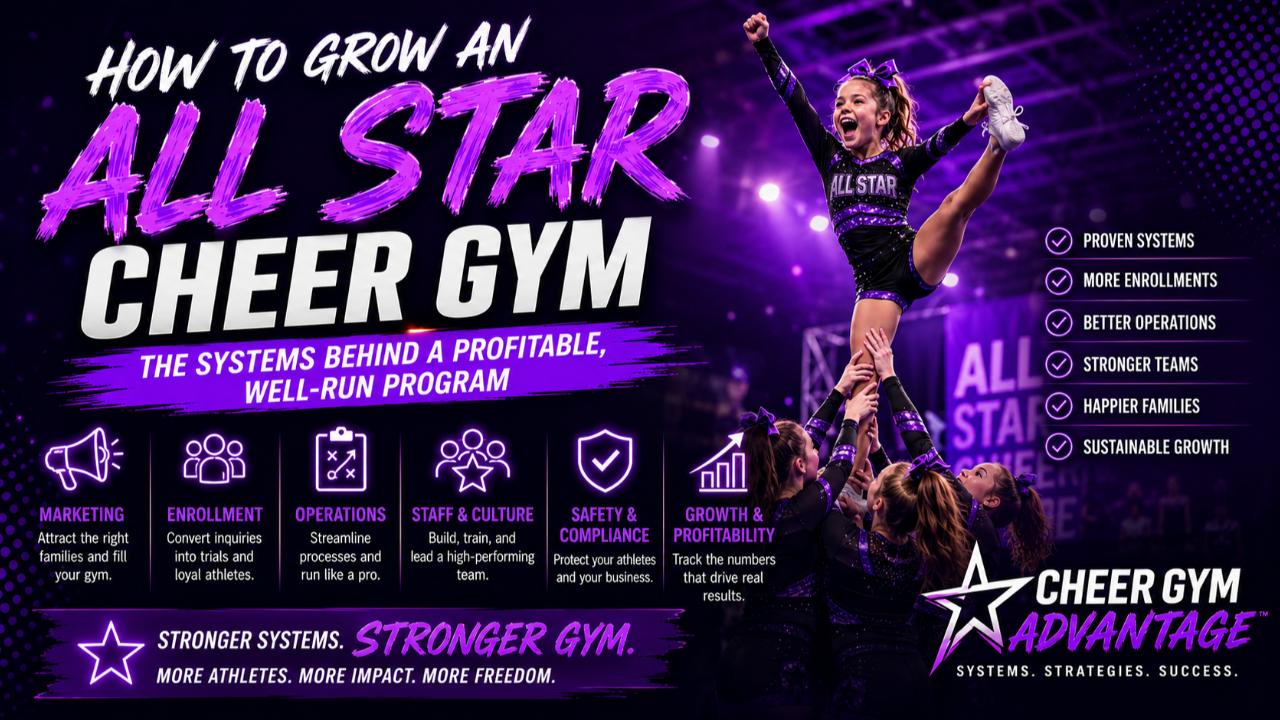
Running an All Star Cheer gym requires far more than great coaching.
A successful gym has to attract new families, convert inquiries into athletes, build competitive teams, develop coaches, communicate with parents, collect tuition, manage competitions, maintain safety standards, retain members, and somehow keep the business moving forward at the same time.
For many owners, that creates a frustrating reality:
The gym may have a great program—but the business behind the program is held together by the owner.
If every important decision, parent problem, staff question, marketing campaign, and operational issue eventually finds its way back to you, growth becomes increasingly difficult.
The solution isn't simply working harder.
It's building a gym that runs on systems.
That is the philosophy behind Cheer Gym Advantage™: helping All Star Cheer gym owners create stronger operations, smarter marketing, better management, and a more scalable business.
Great Cheer Programs Need Great Business Systems
Most gym owners didn't get into All Star Cheer because they dreamed about KPIs, employee onboarding, customer acquisition funnels, financial controls, or operating procedures.
They got into it because they love cheerleading.
They wanted to coach athletes, build teams, create opportunities, compete, and make an impact.
But once a program grows, passion alone isn't enough.
You are no longer simply coaching cheerleading.
You are running a business.
And businesses need systems.
Consider how many different functions happen inside an established cheer gym:
- Lead generation and sales
- Trials and evaluations
- Athlete placement
- Registration and billing
- Team practices
- Tumbling instruction
- Private lessons
- Parent communication
- Employee hiring and training
- Competition preparation
- Safety and emergency procedures
- Customer service
- Marketing
- Retention
- Financial management
- Leadership and accountability
When those areas depend primarily on individual employees remembering what to do, inconsistency is almost inevitable.
When they operate from clearly defined processes, expectations, checklists, responsibilities, and measurements, the business becomes easier to manage.
1. Build an Operating System for Your Cheer Gym
One of the biggest differences between a gym that constantly feels chaotic and one that operates professionally is standardization.
Ask yourself:
If one of your key employees unexpectedly disappeared tomorrow, how much knowledge would disappear with them?
That's the operational risk created when procedures exist primarily inside people's heads.
Your gym should have documented procedures for recurring activities such as athlete registration, evaluations, team placement, practice operations, front desk responsibilities, competition preparation, parent communication, financial processes, safety procedures, and employee onboarding.
This doesn't mean eliminating personality or turning your staff into robots.
It means establishing a clear standard for how your gym operates.
That is precisely what an operating system such as The All Star Gym OS™ is intended to accomplish: give owners a framework for creating consistency throughout the organization.
The goal is simple:
Your gym should operate according to its systems—not according to who happens to be working that day.
2. Clearly Define Staff Roles and Accountability
As gyms grow, job responsibilities frequently become blurry.
Who owns athlete retention?
Who follows up with new leads?
Who handles a parent complaint?
Who monitors past-due accounts?
Who is responsible for practice productivity?
Who reviews coach performance?
Who makes the final decision when multiple departments are involved?
When nobody clearly owns an outcome, tasks get missed. When multiple people believe someone else is responsible, accountability disappears.
Every major position in your gym should have defined:
Purpose → Responsibilities → Authority → KPIs → Reporting Structure → Escalation Procedures
That applies to everyone from your General Manager and All Star Director to coaches, tumbling instructors, front desk staff, sales personnel, and administrative employees.
A Responsibility Matrix can further define who is responsible, accountable, consulted, and informed when important processes cross departments.
Clear accountability isn't micromanagement.
It gives good employees the clarity they need to perform.
3. Stop Treating Marketing as Random Promotion
One of the most common cheer gym marketing problems is inconsistency.
Enrollment slows down.
The gym suddenly needs athletes.
Someone decides:
"We need to post more on Facebook."
A promotion gets created. Some posts go out. Maybe an ad runs.
Then things get busy again and marketing slows down.
That isn't a customer acquisition system.
A strong cheer gym marketing strategy should consistently move families through a defined journey:
Awareness → Interest → Lead → Trial/Evaluation → Enrollment → Retention → Referral
Each stage has a different objective.
Social media can create awareness and trust.
Google can capture parents actively searching for cheerleading, tumbling, or activities for their children.
Community partnerships can introduce your gym to entirely new audiences.
Events can give hesitant families a low-pressure first experience.
Referral programs can turn existing customers into advocates.
Follow-up systems can convert inquiries that aren't ready to enroll immediately.
When these strategies work together, marketing becomes an engine rather than a collection of disconnected tactics.
That's the thinking behind The Growth Playbook™ and The Customer Acquisition Engine inside Cheer Gym Advantage™.
4. Understand Why Families Actually Choose a Cheer Gym
Marketing becomes much easier when you understand something important:
Parents aren't necessarily buying cheerleading.
Different families are buying different outcomes.
One parent may want their child to develop confidence.
Another wants a competitive environment.
Another is looking for friendships and belonging.
A former gymnast may miss competition but want something different.
A dancer may want a more team-oriented experience.
A parent of a younger child may simply want an activity where their child can burn energy, learn skills, and have fun.
A teenager may care deeply about team culture, friendships, competition, and belonging.
That's why effective cheerleading marketing requires understanding the psychology behind the enrollment decision.
Your marketing should address:
What does this family want?
What are they worried about?
What would prevent them from enrolling?
What would make them take the next step today?
Resources such as The Customer Psychology Map and Customer Avatars are designed around this principle.
The better you understand your customer, the less your marketing feels like advertising—and the more it feels like an answer to something the family was already looking for.
5. Become the Cheer Gym Your Community Knows
Your strongest competitive advantage may be geographic.
Most cheer gyms don't need thousands of customers from across the country.
They need the right families within driving distance.
That makes local marketing exceptionally important.
When a parent searches for terms such as:
"cheerleading near me"
"competitive cheer near me"
"tumbling classes near me"
"cheer gym near me"
"All Star Cheer near me"
you want your gym to be visible.
But local domination goes beyond search rankings.
It includes your Google presence, reviews, community reputation, schools, parent groups, partnerships, events, sponsorships, local organizations, and word of mouth.
Your goal should be to create enough visibility that when a parent begins considering cheerleading, your gym is already familiar to them.
That's the strategy behind Local Domination and The 90-Day Local Domination Plan.
Don't simply advertise in your community.
Become part of it.
6. Build Partnerships Instead of Buying Every Lead
Paid advertising can be valuable, but not every new athlete needs to originate from an advertisement.
Your community is filled with organizations that already have relationships with the exact families you want to reach.
Consider potential relationships with:
Schools, preschools, daycares, gymnastics programs, dance studios, youth sports organizations, camps, local businesses, family-oriented organizations, community groups, and other complementary programs.
The objective isn't to walk into another organization asking:
"What can you do for my gym?"
Start with:
"What could we create together that benefits both organizations and the families we serve?"
That difference matters.
A well-designed partnership can generate awareness, referrals, events, credibility, and long-term access to new audiences.
That's why Partnership Acquisition Machine and School Acquisition System are important components of a broader customer acquisition strategy.
Relationships can become marketing assets.
7. Engineer Better Offers
Sometimes the problem isn't traffic.
It's the offer.
Imagine two advertisements.
One says:
"Now Enrolling for Cheerleading Classes."
The other gives a parent a specific, low-friction reason to experience the gym.
The second offer may dramatically outperform the first even if both reach exactly the same audience.
Effective offers combine several elements:
Audience + Desired Outcome + Value + Incentive + Reduced Risk + Urgency + Clear Next Step
This is where Offer Engineering becomes important.
Instead of immediately discounting tuition, think about how you can increase perceived value and make the first step easier.
That might involve an introductory experience, clinic, assessment, special event, trial, evaluation, bonus, or another strategically designed entry point.
Better marketing cannot permanently compensate for a weak offer.
8. Turn Events Into Customer Acquisition Tools
Your gym is uniquely positioned to create experiences that are difficult to communicate through an advertisement alone.
A child can walk into the gym, see athletes practicing, meet coaches, try a skill, experience the energy, and imagine themselves becoming part of it.
That's powerful.
Open houses, beginner clinics, skill challenges, bring-a-friend events, themed experiences, camps, showcases, and community events can all serve as customer acquisition opportunities.
But there's an important distinction:
An event isn't automatically a marketing system.
A customer acquisition event should intentionally answer:
Who are we trying to attract?
How will we promote it?
How will we capture registrations?
What experience will participants have?
What happens after the event?
What is the enrollment offer?
Who follows up?
How will we measure success?
That's the philosophy behind 20 Customer Acquisition Events.
Don't simply create attendance.
Create a path from attendance to enrollment.
9. Build a Referral Engine
Your existing families may be one of the most valuable marketing assets in your gym.
They already know your coaches.
They understand your culture.
Their children have experienced your program.
And they likely know other parents with children similar to yours.
Yet many gyms leave referrals entirely to chance.
A structured referral strategy can include parent referrals, athlete referrals, sibling opportunities, friend passes, team challenges, ambassador initiatives, special events, and seasonal campaigns.
The key is making referrals easy, intentional, visible, and rewarding.
Your Referral Engine should turn exceptional customer experiences into customer acquisition.
When families genuinely love your program, give them opportunities to help other families discover it.
10. Make Social Media Generate Business Results
Followers are nice.
Engagement is useful.
Views can expand awareness.
But ultimately, your social media should support business objectives.
For an All Star Cheer gym, your content can demonstrate:
Culture. Coaching. Athlete development. Confidence. Friendships. Competition. Progress. Community. Results.
Parents who have never stepped inside your facility can begin understanding what makes your gym different.
Your content should also answer questions and objections.
What if my child has never cheered before?
Is competitive cheer only for experienced athletes?
What happens at an evaluation?
What is tumbling?
How much commitment is involved?
What does my child gain beyond cheer skills?
These are marketing opportunities.
Social Media That Acquires Customers is built around moving beyond posting simply to stay active.
Every piece of content should have a job.
Some content attracts.
Some educates.
Some builds trust.
Some handles objections.
Some proves results.
And some asks the prospect to take action.
11. Create an Exceptional Parent Experience
Customer acquisition gets expensive when retention is poor.
If you enroll ten athletes while another ten leave, you're working extremely hard to remain in the same place.
That's why growth isn't exclusively a marketing responsibility.
Operations and customer experience are growth strategies too.
Parents should know:
Where to get information.
Who to contact.
When they can expect a response.
How concerns are handled.
How schedule changes are communicated.
How billing questions are resolved.
What happens when an issue needs to be escalated.
Professional Parent Communication systems can dramatically improve consistency and reduce unnecessary friction.
Every interaction contributes to how a family perceives your organization.
That perception influences retention, reviews, referrals, and reputation.
12. Improve the Quality of Every Practice
Parents may not understand every technical detail of cheerleading.
But they recognize progress.
They notice whether practices appear organized.
Athletes know whether practices feel productive.
Coaches know when too much time is being lost.
A gym should therefore measure more than attendance.
Practice operations should consider:
Preparation → Warm-Up → Skill Development → Stunting → Tumbling → Routine Work → Full-Outs → Conditioning → Athlete Feedback → Coach Notes
Tools such as Practice Operations Checklists, Practice Time – Sample Outlines, and a Practice Productivity Scorecard can help coaches use training time more intentionally.
Great coaching will always require judgment.
Systems simply help great coaches deliver that judgment more consistently.
13. Build a Better Employee Onboarding System
One of the fastest ways to create inconsistency is to hire someone and tell them:
"Just shadow Sarah for a few days."
Shadowing can be valuable.
It shouldn't be the entire training program.
A professional 30-Day Employee Onboarding process should establish expectations from the beginning and gradually move employees toward independent competency.
That includes:
Role expectations.
Policies.
Professional standards.
Systems access.
Job-specific procedures.
Shadowing.
Supervised execution.
Competency assessments.
Feedback.
Performance expectations.
Formal sign-off.
This becomes especially important as your organization grows.
You cannot scale a business if every employee learns the job differently.
14. Manage the Gym Through Numbers
Revenue tells you what already happened.
Strong management also monitors the indicators that tell you what is likely to happen next.
An All Star Cheer gym KPI scorecard might monitor metrics such as:
Lead volume.
Lead response rate.
Trial bookings.
Show rate.
Trial-to-enrollment conversion.
Athlete retention.
Class utilization.
Accounts receivable.
Revenue per athlete.
Staffing costs.
Practice productivity.
Referral volume.
Marketing cost per lead.
Enrollment revenue.
These metrics allow leadership to identify problems while there is still time to respond.
If inquiries are falling, marketing needs attention.
If inquiries are strong but trials are weak, follow-up may be the problem.
If trials are strong but enrollment is weak, the sales process, offer, pricing, or customer experience may require attention.
If enrollment is strong but revenue isn't growing, retention or pricing could be the issue.
An Executive KPI Scorecard helps transform management from:
"Something feels wrong."
into:
"Here is exactly where the system is breaking."
The Bigger Goal: Build a Gym That Can Grow Without Creating More Chaos
There is a point where working harder stops solving the problem.
The owner becomes the bottleneck.
Every decision requires approval.
Every employee has another question.
Every parent problem reaches management.
Marketing happens when someone remembers.
Procedures vary depending on who is working.
Growth actually creates more stress instead of more freedom.
That is exactly what systems are designed to solve.
Imagine your gym with:
Clear staff accountability.
Documented operating procedures.
Structured employee onboarding.
Consistent parent communication.
Measurable practice standards.
Professional safety procedures.
A predictable customer acquisition engine.
Strong local visibility.
Strategic partnerships.
Referral systems.
Marketing that happens consistently.
KPIs that tell management exactly where attention is needed.
And a leadership rhythm that keeps the organization moving toward its goals.
That is a fundamentally different business.
That's Why We Built Cheer Gym Advantage™
Cheer Gym Advantage™ is built for All Star Cheer gym owners who want more than another collection of generic business advice.
The goal is to provide practical systems, strategies, templates, checklists, scorecards, operating tools, and growth resources specifically for the realities of running an All Star Cheer gym.
Inside The Advantage Vault™, gym owners can access resources covering areas such as:
Operations • Management • Marketing • Customer Acquisition • Employee Training • Front Desk • Parent Communication • Safety • Financial Management • KPIs • Athlete Placement • Practice Operations • Growth
And The Advantage Vault™ will continue to grow, with new resources added to help gym owners address more areas of their businesses.
Because building a successful cheer gym isn't about finding one magic marketing campaign.
It's about building a better business one system at a time.
Ready to Build Your Cheer Gym Advantage?
If you want to increase enrollment, improve operations, strengthen your team, create better systems, and build a gym capable of sustainable growth, explore Cheer Gym Advantage™ and discover the resources inside The Advantage Vault™.
Run Smarter. Grow Stronger. Build Your Advantage.
