
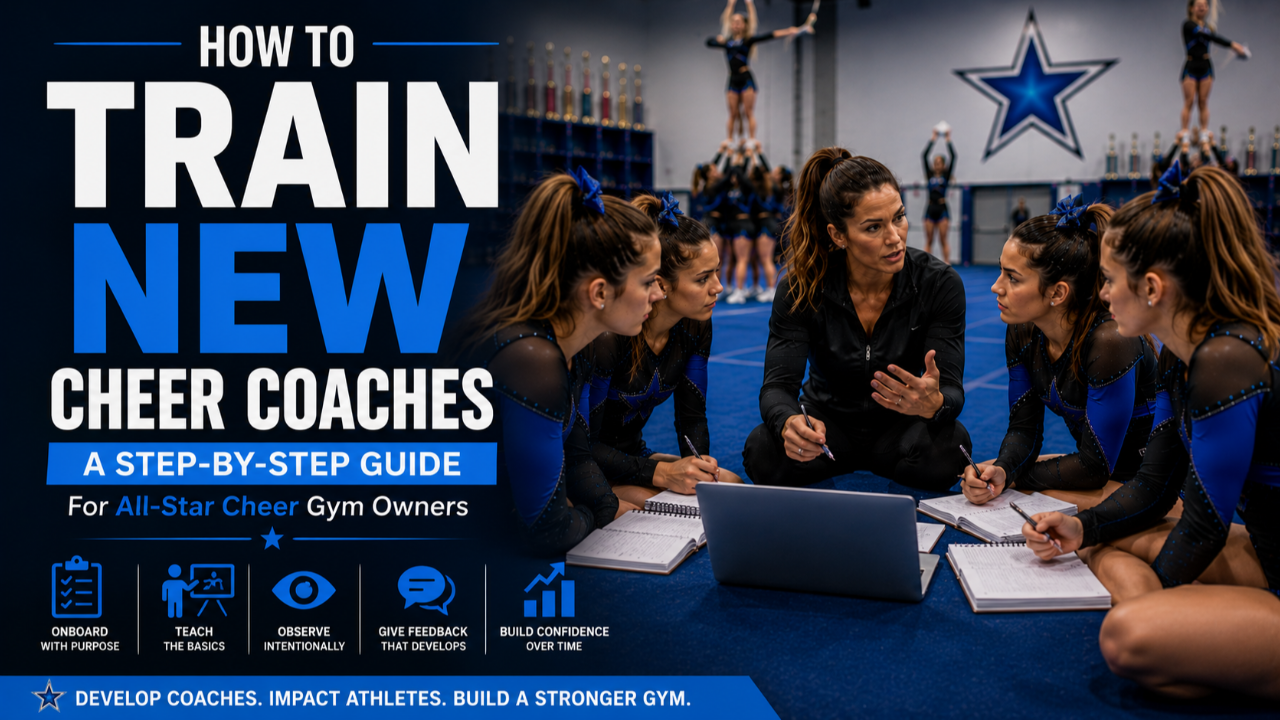
How to Train New Cheer Coaches: A Step-by-Step Guide for All-Star Cheer Gym Owners
Hiring someone who knows cheerleading is relatively easy.
Developing that person into an effective professional coach is something entirely different.
This distinction is especially important in All-Star Cheer, where many new coaches enter the profession after years of competing themselves. They may have tremendous technical knowledge, understand the terminology, know your program, and possess an instinctive understanding of the sport.
But there is one problem.
Knowing cheerleading doesn't automatically mean someone knows how to teach cheerleading.
If you want to know how to train new cheer coaches effectively, the answer isn't simply more technical instruction.
New coach development should intentionally build technical competence, instructional ability, communication skills, professional judgment, safety awareness, practice-management skills, and the ability to help athletes actually learn.
Here is how All-Star Cheer gym owners can build a more structured approach.
Why New Cheer Coach Training Matters
Think about how carefully you develop athletes.
You don't normally take an athlete who has never performed a particular skill, explain it once, and immediately expect mastery.
You introduce appropriate progressions.
You observe.
You provide feedback.
You allow practice.
You evaluate performance.
You identify weaknesses.
You provide additional instruction.
You gradually increase responsibility.
Yet gyms sometimes do almost the opposite with new coaches.
A former athlete expresses interest in coaching.
They shadow a few practices.
Someone explains the schedule.
They learn a few administrative procedures.
Then they are given a group of athletes.
That isn't necessarily coach development.
It can become learning through trial and error—with your athletes serving as the trial.
A better system develops the coach deliberately.
Step 1: Separate Cheerleading Knowledge From Coaching Ability
The first step in training a new cheer coach is recognizing that technical knowledge and instructional competence are separate capabilities.
Someone can be an exceptional tumbler without being an exceptional tumbling instructor.
Someone can have extensive stunt experience without knowing how to diagnose why an athlete is struggling.
Someone can have competed at a high level without knowing how to structure a productive practice.
And someone can understand exactly what a skill should look like without being able to explain that skill to a developing athlete.
This is especially important when former athletes become coaches.
Their experience is valuable.
But don't confuse experience performing cheerleading with experience teaching cheerleading.
Evaluate both.
Ask:
What technical knowledge does this person possess?
What are they appropriately qualified to teach?
How effectively do they communicate?
Can they explain a concept clearly?
Can they observe athlete performance?
Can they identify priorities?
How do they respond when an athlete doesn't understand?
Can they adapt their explanation?
How do they interact with athletes?
Do they understand professional boundaries?
Can they manage a group?
Can they accept feedback?
Do they demonstrate sound judgment?
The answers help determine where development needs to begin.
Step 2: Start With Professional Expectations Before Coaching Technique
Before a new coach begins worrying about sophisticated instructional strategies, they need to understand what being an employee and professional coach means inside your organization.
Your new cheer coach onboarding process should establish expectations around areas such as:
Professional conduct.
Attendance and punctuality.
Dress and appearance.
Communication.
Athlete interaction.
Parent interaction.
Professional boundaries.
Electronic communication.
Social media.
Facility expectations.
Incident reporting.
Emergency procedures.
Athlete protection.
Confidentiality.
Escalation procedures.
Staff communication.
Documentation.
Who has decision-making authority.
A talented coach who doesn't understand professional expectations can create substantial problems for an organization.
Professionalism should therefore be treated as a foundational coaching competency, not an administrative afterthought.
Step 3: Define What the New Coach Is Actually Qualified to Teach
One of the most important decisions in new cheer coach training is determining scope.
A new employee should not automatically receive permission to teach every skill simply because they have personally performed those skills.
Gym leadership should determine what the coach is qualified and authorized to teach based on applicable credentials, demonstrated competence, current governing requirements, insurer requirements, technical leadership standards, safety considerations, and organizational policy.
Create clear boundaries.
A developing coach should know:
What can I teach independently?
What can I assist with?
What requires supervision?
What am I not currently authorized to teach?
This protects athletes while also giving the coach a visible development pathway.
As competence increases and applicable requirements are satisfied, responsibility can increase.
Step 4: Teach New Coaches How Athletes Learn
This is where many traditional cheer coach training programs remain too narrow.
Coaches learn drills.
They learn progressions.
They learn corrections.
But they may receive relatively little education about the person actually receiving the instruction.
The athlete.
New coaches should develop a basic understanding of learning.
They need to recognize that athletes have limited attention.
That giving more information does not automatically produce more learning.
That understanding and physical execution are not the same thing.
That immediate performance does not always equal long-term retention.
That feedback can help or hinder learning depending on how it is delivered.
That confidence, fear, motivation, fatigue, prior experience, and skill readiness can affect performance.
And that different athletes may require different explanations for the same concept.
This changes the coach's mindset.
Instead of asking:
"Did I explain it?"
they begin asking:
"Did the athlete understand it?"
That is a much more useful coaching question.
Step 5: Teach Coaches How to Observe Before They Correct
Beginning coaches frequently want to prove they know what they're doing.
An athlete performs a skill and the coach immediately starts correcting.
But professional coaching begins with observation.
Before speaking, the coach should be learning to ask:
What actually happened?
Not:
What correction do I usually give for this skill?
Those are different questions.
New coaches need practice observing athlete performance without immediately jumping to a conclusion.
Have them watch.
Ask what they saw.
Ask what they believe the highest-priority issue is.
Ask what evidence supports that conclusion.
Then ask what they would do next.
This helps develop coaching judgment instead of simply memorizing correction scripts.
Step 6: Teach Coaches to Prioritize Corrections
A developing coach can sometimes identify numerous things that are wrong with a skill.
That doesn't mean they should say all of them.
Imagine an athlete finishes an attempt and receives six corrections.
Every correction may be technically accurate.
But the athlete now needs to remember six different things before attempting the skill again.
More information isn't always better instruction.
Teach new coaches to ask:
What is the most important thing this athlete needs right now?
There may be situations where one correction influences several other problems.
There may be a safety issue that must be addressed first.
There may be a missing prerequisite that makes every other correction irrelevant.
The ability to prioritize is one of the characteristics that separates inexperienced coaching from increasingly sophisticated instruction.
Step 7: Develop a Coaching Vocabulary
New coaches frequently know what something should feel like but struggle to explain it.
This is particularly common with former athletes.
They performed a movement thousands of times.
It became automatic.
Now they need to explain that movement to someone who doesn't possess the same experience.
That requires language.
Help new coaches develop a library of clear, concise coaching cues.
Then teach them an important additional skill:
Don't become dependent on one cue.
If an athlete doesn't understand the first explanation, repeating the same words louder isn't necessarily going to help.
The coach should be capable of changing the explanation.
Use different language.
Demonstrate.
Ask a question.
Break the movement into a smaller component.
Use an appropriate analogy.
Return to a prerequisite.
The objective isn't for the coach to deliver their favorite cue.
The objective is for the athlete to understand.
Step 8: Teach New Cheer Coaches How to Give Feedback
Feedback is one of the most powerful tools a coach has.
It is also one of the easiest to misuse.
Beginning coaches may provide feedback constantly because they believe more feedback equals more coaching.
But athletes also need opportunities to process movement, develop awareness, solve problems, and recognize their own performance.
New coaches should learn that feedback can serve different purposes.
Sometimes athletes need information about what happened.
Sometimes they need information about how to improve.
Sometimes they need confirmation that an adjustment worked.
Sometimes they need a question that forces them to evaluate their own performance.
And sometimes they need another attempt without additional information.
The important skill is not simply giving feedback.
It is learning when feedback is useful, what feedback matters, and how much feedback the athlete needs.
Step 9: Teach Practice Management, Not Just Skill Instruction
A coach can be technically knowledgeable and still run an ineffective practice.
New cheer coaches need to understand that practice time is a finite resource.
Every minute matters.
Teach coaches to think about:
Practice objectives.
Transitions.
Equipment preparation.
Group organization.
Athlete wait time.
Repetition opportunities.
Instruction time.
Water breaks.
Skill sequencing.
Individual feedback.
Team development.
Conditioning.
Routine work.
Practice closure.
The objective isn't simply keeping athletes busy.
Activity and productivity are not the same thing.
A practice can look extremely active while producing surprisingly little meaningful learning.
Teach new coaches to evaluate practice based on outcomes rather than noise and movement.
Step 10: Require Observation With a Purpose
Shadowing experienced coaches can be valuable when the new coach knows what to observe.
Instead of saying:
"Watch Sarah's practice tonight."
give the developing coach an observation assignment.
For example:
Watch how the coach starts practice.
Record how many different instructional methods you observe.
Identify three examples of feedback.
Watch how the coach handles an athlete who doesn't understand.
Identify how transitions are managed.
Observe how much time athletes spend waiting.
Identify one moment when the coach changes their instructional strategy.
Observe how the coach closes practice.
Then discuss the observations afterward.
Structured observation turns shadowing from passive watching into professional development.
Step 11: Move From Observation to Supervised Application
Eventually, new coaches need to coach.
But responsibility does not need to jump from zero to one hundred.
Use progressive responsibility.
A developing coach might first observe.
Then assist.
Then lead a warm-up.
Then teach one drill.
Then teach a short segment.
Then manage a small group.
Then lead a larger portion of practice.
Eventually, they may run an entire class or practice within their authorized scope.
During this process, an experienced leader should observe.
Afterward, provide specific feedback.
What worked?
What didn't?
What did the coach notice?
What did they miss?
How did athletes respond?
What would they change next time?
This creates a development cycle:
LEARN → OBSERVE → APPLY → RECEIVE FEEDBACK → ADJUST → APPLY AGAIN
That cycle is significantly more powerful than simply assigning training material and checking a completion box.
Step 12: Evaluate Coaching, Not Personality
Some coaches are naturally charismatic.
They are loud.
Athletes like them.
They bring energy into the gym.
Those qualities can be valuable.
But charisma should not be confused with coaching effectiveness.
When evaluating new coaches, look beyond personality.
Evaluate behaviors.
Can they explain clearly?
Do athletes understand instructions?
Can they identify priorities?
Do they provide useful feedback?
Are they appropriately engaged?
Do they maintain professional boundaries?
Do they manage time?
Do they follow safety requirements?
Can they adapt?
Do they accept feedback?
Are athletes learning?
A quieter coach may ultimately become an exceptional teacher.
A charismatic coach may still need substantial instructional development.
Evaluate what matters.
Step 13: Create Delayed Checks
A common training mistake is evaluating someone immediately after instruction and assuming learning occurred.
The coach finishes a lesson.
They answer questions correctly.
Training is marked complete.
But can they remember and apply the information next week?
Can they use it during practice?
Can they recognize when the principle applies in a different situation?
Consider incorporating delayed checks into your cheer coach development program.
Return to important concepts later.
Ask coaches to explain them.
Observe whether they are applying them.
Use scenarios.
Ask what they would do and why.
Training should produce durable professional capability, not temporary answers.
Step 14: Use Remediation as Development, Not Punishment
When a coach struggles, don't automatically treat the problem as disciplinary.
First determine what type of problem exists.
Is it a knowledge problem?
A skill problem?
A judgment problem?
A communication problem?
A motivation problem?
A policy violation?
A safety issue?
Different problems require different responses.
If a coach genuinely doesn't know how to provide effective feedback, additional development may be appropriate.
If the coach understands the requirement but repeatedly refuses to follow it, that becomes a different management issue.
Effective leaders distinguish between can't do and won't do.
Training addresses the first.
Accountability addresses the second.
Step 15: Create an Ongoing Cheer Coach Development Path
New coach training should not have an expiration date.
Your objective isn't merely to create someone competent enough to run a class.
Your objective should be continued professional development.
Create levels.
For example:
Core Staff Development
Professional expectations and organizational foundations.
Coach Development
Instruction, learning, communication, feedback, practice design, observation, athlete development, and coaching application.
Advanced Coach Development
More sophisticated decision-making, instructional analysis, athlete learning, and coaching judgment.
Leadership Development
Developing other coaches, establishing standards, evaluating performance, leading teams, and maintaining organizational consistency.
Now employees can see a pathway.
They aren't simply "a coach."
They are developing as professionals.
How Long Should New Cheer Coach Training Take?
There is no universal number of hours that makes someone a qualified cheer coach.
Time alone doesn't establish competence.
A coach who completes twenty hours of material but cannot apply it effectively still requires development.
A coach's progression should consider:
Training completion.
Applicable credentials.
Technical competence.
Observed coaching performance.
Professional conduct.
Safety knowledge.
Communication ability.
Judgment.
Practical application.
Leadership evaluation.
Role requirements.
The goal should be demonstrated capability, not simply accumulated hours.
What Should a New Cheer Coach Training Program Include?
A comprehensive program may include:
Professionalism and employee expectations.
Gym policies and procedures.
Athlete protection and professional boundaries.
Safety and emergency procedures.
Technical scope and responsibilities.
Communication.
Learning principles.
Motor learning concepts.
Instructional methods.
Observation.
Coaching cues.
Feedback.
Practice design.
Athlete engagement.
Skill acquisition.
Retention.
Professional judgment.
Parent interaction.
Leadership expectations.
Supervised application.
Practice observation.
Evaluation.
Remediation.
Ongoing professional development.
The exact requirements should reflect the coach's role, qualifications, applicable standards, and your organization's needs.
Build a System Instead of Rebuilding Coach Training Every Time You Hire
One of the biggest advantages of documenting your new cheer coach training process is scalability.
Without a system, every new hire creates another training project.
Someone has to remember what to teach.
Different managers emphasize different things.
Important topics can be forgotten.
Training quality depends on whoever happens to conduct the onboarding.
And as the gym grows, inconsistencies grow with it.
A documented system changes that.
Your leadership team has a common framework.
Your coaches receive a more consistent foundation.
Your expectations become visible.
And training knowledge stays inside the organization even when employees leave.
The All-Star Cheer Staff Training & Athlete Learning System™
Gym owners shouldn't have to build an entire coach-development curriculum from a blank page.
That is why Cheer Gym Advantage™ created the All-Star Cheer Staff Training & Athlete Learning System™.
It is a comprehensive collection of downloadable, customizable training materials designed specifically for All-Star Cheer organizations.
The complete system includes:
6 PHASES
18 MODULES
72 LESSONS
55 HOURS OF INSTRUCTION
Including approximately:
4.5 hours of Core Staff Training
33 hours of Coach Training
6 hours of Advanced Coach Training
11.5 hours of Leadership Training
The 55-hour instructional catalog excludes additional practice observations, application assignments, delayed checks, remediation, and other practical development activities a gym may incorporate.
Most importantly, the system isn't designed as another locked online course.
The materials are downloadable and customizable.
Gym owners can adapt appropriate materials to their own policies, terminology, standards, staff structure, and coaching culture.
Because the objective isn't to make your gym operate like someone else's.
The objective is to give you a framework for creating a better version of your own staff-development system.
Stop Hoping New Coaches Figure It Out
There will always be an element of experience involved in becoming a great coach.
People need time on the floor.
They need athletes to teach.
They need difficult situations.
They need successes.
They need mistakes.
They need feedback.
But experience becomes much more valuable when it occurs inside a deliberate development process.
Don't simply take someone who knows cheerleading, give them a class, and hope they eventually become an excellent coach.
Give them a path.
Teach them.
Observe them.
Let them apply what they learn.
Give them feedback.
Hold them accountable.
Continue developing them.
Transform people who know cheerleading into professionals who know how to teach cheerleading.
That is how you begin building better coaches—and ultimately, a stronger All-Star Cheer organization.
