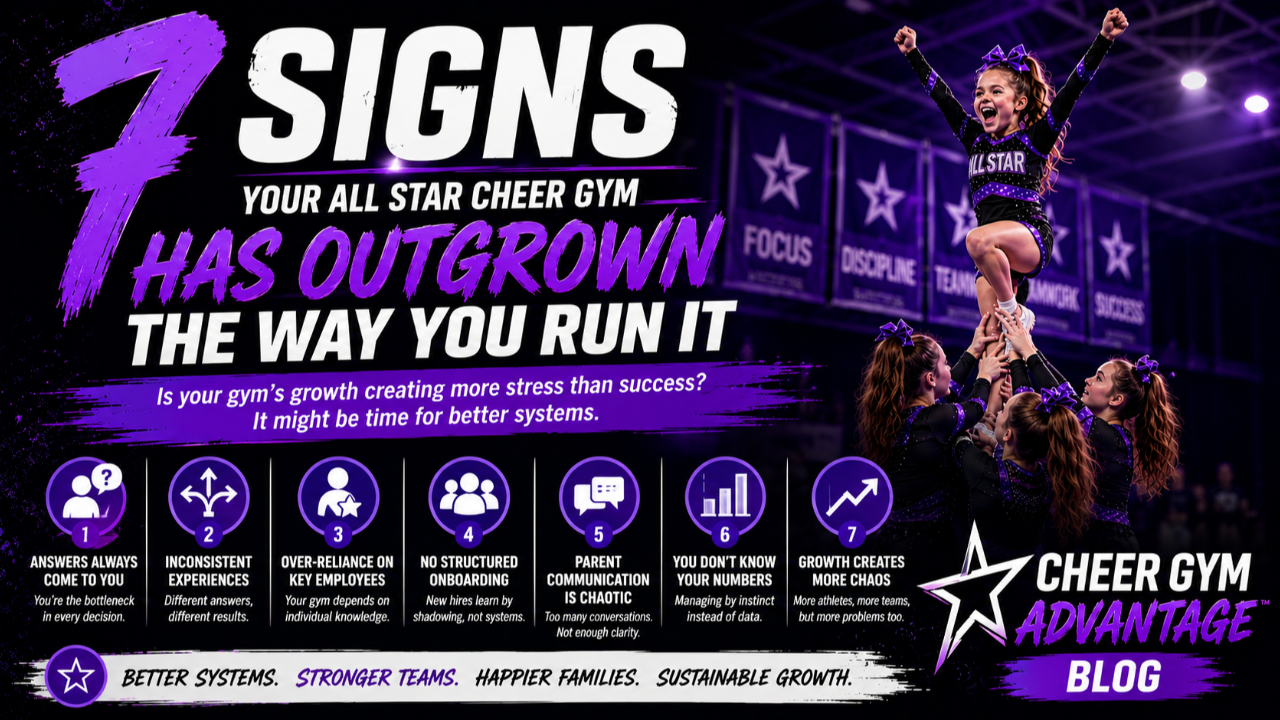
7 Signs Your All Star Cheer Gym Has Outgrown the Way You Run It
Growing an All Star Cheer gym should be exciting.
More athletes. More teams. More coaches. More classes. More revenue. More opportunities.
But growth can also expose every weakness in the way your gym operates.
What worked when you had 75 athletes may become difficult at 150.
What worked with three employees may fall apart with fifteen.
And the owner who could once personally oversee almost everything eventually discovers there simply aren't enough hours in the day.
That's when growth starts creating a dangerous problem:
The gym gets bigger, but the business doesn't get better.
Instead of creating more freedom, success creates more emails, more questions, more parent issues, more staff problems, more decisions, and more dependence on the owner.
The problem isn't necessarily your employees.
And it isn't necessarily growth.
Your gym may simply have outgrown the way it is being run.
Here are seven warning signs.
1. Everyone Comes to You for Answers
You're trying to work on next season's strategy when a coach asks:
"Can this athlete move teams?"
Then the front desk asks:
"Can I give this parent a credit?"
Then another employee asks:
"What should I tell this family?"
Then someone needs approval for a purchase.
Then there's a parent complaint.
Then a coach calls out.
Then someone wants to know what to do about a missed payment.
Suddenly, the day is gone.
If virtually every decision eventually reaches the owner, you don't have delegation.
You have distributed task execution with centralized decision-making.
That's difficult to scale.
The Solution: Define Decision Authority
Your leadership structure should clearly establish:
Who owns the decision?
What can they decide without approval?
When does management need to be involved?
What requires owner approval?
What needs to be documented?
When should something be escalated?
A General Manager shouldn't need owner approval for routine management decisions.
An All Star Director should understand which program decisions fall within their authority.
Front desk employees should know exactly what they can and cannot do when handling billing or customer service issues.
Clear authority doesn't mean giving employees unlimited control.
It means establishing guardrails within which they can confidently operate.
The ultimate goal is not to remove the owner from the business.
It's to remove the owner from decisions someone else should be capable of making.
2. Different Employees Handle the Same Situation Differently
Ask three employees how your gym handles a particular situation.
Do you get the same answer?
Consider:
A parent complaint.
A failed payment.
A trial athlete arriving for the first time.
An injured athlete.
A late athlete.
A uniform issue.
An athlete missing competition practice.
A parent requesting a refund.
A potential customer calling the gym.
A prospective family requesting information.
If the answer depends on which employee happens to be working, you have inconsistency.
And inconsistency eventually becomes a customer experience problem.
One parent gets one answer.
Another parent gets another.
One coach enforces a policy.
Another doesn't.
One employee documents the interaction.
Another never records it.
The Solution: Standard Operating Procedures
Your gym needs documented procedures for recurring situations.
A good SOP doesn't need to turn every interaction into a rigid script.
Instead, it establishes:
The standard.
The process.
The responsible employee.
The required documentation.
The acceptable exceptions.
The escalation point.
This creates consistency without eliminating professional judgment.
Your families should experience the same organization regardless of which employee they interact with.
3. Your Best Employees Are Constantly Training Everyone Else
Every gym has them.
The employees who know everything.
They know where everything is.
They know how the software works.
They know what to tell parents.
They know competition procedures.
They know billing.
They know how evaluations work.
They remember what happened last season.
They know the weird workaround nobody documented.
They're invaluable.
They're also a major operational risk.
Because if your business depends on one person's institutional knowledge, what happens when that employee:
Gets sick?
Takes vacation?
Changes jobs?
Moves?
Gets promoted?
Leaves unexpectedly?
Your employees should be valuable because of their talent—not because they're the only people who know how the business works.
The solution is knowledge transfer through documentation and training.
Important procedures should exist outside individual employees' memories.
Checklists should capture recurring responsibilities.
Training materials should teach standards.
Onboarding should transfer institutional knowledge intentionally.
Systems should create consistency.
Your strongest employees can then focus on performing and leading instead of repeatedly explaining the same procedures.
4. New Employees Learn Mostly by Shadowing Someone
There's nothing wrong with shadowing.
It's actually an important training method.
The problem begins when your onboarding program is essentially:
"Follow Jessica around until you figure it out."
What exactly is the employee supposed to learn?
When should they know it?
How do you determine whether they're competent?
Who verifies their training?
Which policies have they reviewed?
What happens if the person they're shadowing has developed bad habits?
Without structured onboarding, new employees often learn a mixture of:
Official procedures.
Personal preferences.
Shortcuts.
Old policies.
Unwritten rules.
And whatever happens to occur during their first few shifts.
Build a Defined Employee Onboarding Process
Your onboarding system should intentionally move an employee from:
Orientation → Training → Observation → Supervised Execution → Competency → Independent Responsibility
A structured 30-Day Employee Onboarding program can establish specific milestones for:
Day 1
Culture, policies, expectations, systems, introductions, and role overview.
Week 1
Core procedures and shadowing.
Week 2
Guided execution of responsibilities.
Week 3
Increasing independence and competency assessment.
Day 30
Formal review, feedback, competency sign-off, and next-stage development.
Employees should know what success looks like.
Managers should know what must be taught.
And ownership should know that training actually occurred.
5. Parent Communication Consumes Too Much Management Time
Parents are essential stakeholders in your business.
They deserve accurate information, professional communication, and appropriate access to management when necessary.
But without a communication structure, small issues can quickly consume enormous amounts of leadership time.
A coach receives a message.
The coach responds.
The parent contacts the front desk.
The front desk gives a different answer.
The parent emails the director.
Someone forwards it to the owner.
Now five people are involved in something that could have been resolved by one.
Create a Parent Communication System
Define which communication belongs with:
Coaches
Front Desk
Program Directors
Management
Ownership
Then establish escalation levels.
For example:
Level 1 — Routine Question
Schedule, uniform, event, registration, or basic program information.
Level 2 — Service Concern
A problem requiring follow-up or management attention.
Level 3 — Significant Complaint
Coach concerns, recurring issues, financial disputes, or sensitive situations.
Level 4 — Immediate Escalation
Safety, athlete protection, serious injury, threats, or other high-risk situations.
Now employees aren't guessing.
Parents get clearer answers.
Management gets involved when management is actually needed.
And serious concerns reach the appropriate person faster.
6. You're Busy—but You're Not Sure Whether the Gym Is Actually Improving
Your practices are full.
Phones are ringing.
Staff are busy.
Teams are competing.
Your calendar is packed.
Everyone is working.
But ask a more difficult question:
Is the business getting better?
Do you know your:
Lead-to-trial conversion rate?
Trial show rate?
Trial-to-enrollment rate?
Athlete retention rate?
Revenue per athlete?
Accounts receivable?
Class utilization?
Referral rate?
Marketing cost per lead?
Enrollment revenue?
Staff labor percentage?
If the answer is no, management decisions may be based largely on instinct.
Instinct matters.
Data makes instinct more useful.
Build an Executive KPI Scorecard
Your scorecard should include both leading and lagging indicators.
Lagging indicators tell you what happened.
Revenue is a good example.
Leading indicators can provide clues about what may happen next.
If lead volume declines substantially this month, enrollment may decline later.
If trial bookings are increasing, future enrollment may increase.
If attendance deteriorates, retention could eventually suffer.
The purpose isn't to drown management in spreadsheets.
It's to identify the small group of numbers that tell you whether the business is moving in the right direction.
7. Growth Creates More Chaos Instead of More Capacity
This is perhaps the clearest warning sign.
You add 50 athletes.
Revenue increases.
But now:
Your front desk is overwhelmed.
Your coaches are frustrated.
Parent communication increases.
Billing becomes harder.
The owner works longer hours.
Management meetings become reactive.
Problems fall through the cracks.
And everyone says:
"We're just really busy right now."
Except "right now" lasts six months.
That's not simply a workload problem.
It's a scalability problem.
A scalable business doesn't require workload to remain flat as revenue increases.
But the relationship shouldn't be one-for-one either.
If every 20% increase in enrollment creates 20% more chaos for ownership, eventually you hit a ceiling.
Systems Create Capacity
Good systems make repeated activities easier to execute.
Checklists reduce forgotten steps.
SOPs reduce unnecessary questions.
Training reduces errors.
Accountability reduces bottlenecks.
Automation reduces repetitive work.
KPIs identify problems sooner.
Management rhythms create structured decision-making.
Clear roles distribute responsibility.
That's how an organization develops the capacity to handle more business.
The Owner Should Not Be the Operating System
This is the fundamental issue.
In many growing cheer gyms, the owner effectively becomes the operating system.
The owner remembers.
The owner decides.
The owner checks.
The owner fixes.
The owner approves.
The owner follows up.
The owner resolves.
The owner knows what happens next.
That can work surprisingly well for a while.
Especially if you're highly capable.
But eventually the business reaches the maximum amount of complexity one person can personally coordinate.
At that point, working harder isn't the solution.
The operating system needs to move out of your head and into the organization.
That means creating:
Documented procedures.
Clear staff responsibilities.
Defined decision authority.
Training systems.
Checklists.
Communication standards.
Management routines.
Scorecards.
Reporting.
Escalation procedures.
Quality standards.
When those elements exist, the organization becomes less dependent on individual memory.
What a Systemized Cheer Gym Looks Like
Imagine walking into your gym and seeing a different environment.
The front desk knows exactly how to handle new inquiries.
New leads receive consistent follow-up.
Trials follow a defined process.
Coaches understand expectations.
Practices operate according to established standards.
Parents know where to direct questions.
Managers know what they own.
Employees understand when to escalate problems.
New hires follow structured onboarding.
Financial processes have controls.
Safety procedures are documented.
Management reviews KPIs every week.
Leadership meetings focus on improvement rather than putting out fires.
Marketing continues even when the gym gets busy.
You still have problems.
Every business does.
But instead of every problem becoming your problem, the organization has a mechanism for handling it.
That's the difference.
Start With the Processes That Cause the Most Pain
Don't attempt to document your entire gym this weekend.
Start with the areas creating the greatest amount of friction.
Make a list of every question employees repeatedly ask you for the next two weeks.
Then look at it.
You may discover patterns.
Maybe you answer billing questions constantly.
That's a financial procedure problem.
Maybe coaches repeatedly ask about athlete placement.
That's an authority or placement-process problem.
Maybe parents constantly contact the wrong person.
That's a communication-system problem.
Maybe new employees repeatedly make the same mistakes.
That's an onboarding problem.
Maybe leads aren't receiving consistent follow-up.
That's a sales-process problem.
Every repeated question is potentially telling you:
"A system should probably exist here."
Document the answer once.
Train the team.
Assign ownership.
Measure compliance.
Improve the process.
Then move to the next bottleneck.
Build a Business That Doesn't Depend on You for Everything
The goal isn't to make your gym impersonal.
Quite the opposite.
Systems can give your people more capacity to focus on people.
When coaches aren't confused about procedures, they can focus on athletes.
When front desk employees have clear standards, they can focus on service.
When managers have authority, they can lead.
When employees know expectations, they can perform.
And when owners aren't constantly solving routine operational problems, they can focus on the work only ownership can do:
Vision. Strategy. Leadership. Culture. Growth.
Build Your Gym's Operating Advantage
Cheer Gym Advantage™ was created to help All Star Cheer gym owners build the systems behind a stronger business.
Inside The Advantage Vault™, owners can access practical resources designed around the real operational challenges of running an All Star Cheer gym, including tools for:
Staff Positions & Accountability
Responsibility Matrix
30-Day Employee Onboarding
Employee Training & Competency
Parent Communication
Front Desk Procedures
Practice Operations
Financial Management
Safety, Injury & Emergency Operations
Management Operating Rhythm
Executive KPI Scorecard
The All Star Gym OS™
…and more.
The objective isn't to add another pile of documents to your business.
It's to help turn the things your gym knows it should be doing into systems your organization can consistently execute.
Because growth shouldn't mean the owner has to work harder every season.
It should mean the business becomes stronger, smarter, and more capable.
