
Why More Leads Won’t Fix Your Cheer Gym’s Growth Problem
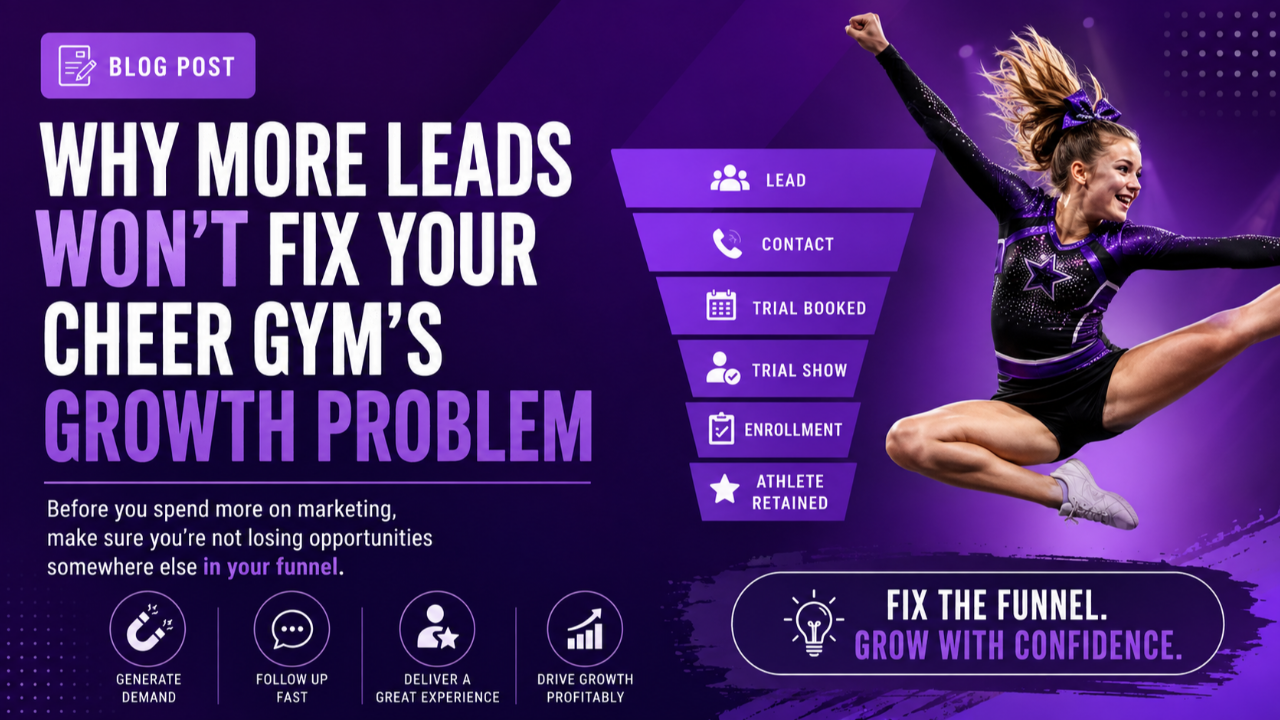
When enrollment starts slowing down, one of the first reactions many All-Star Cheer gym owners have is:
“We need more leads.”
Sometimes that is exactly right.
But sometimes it is the most expensive wrong answer you can choose.
You can double your advertising budget, generate twice as many inquiries, and still barely increase athlete count if the real problem is happening somewhere else in the business.
The issue could be slow follow-up.
It could be weak trial booking.
It could be families failing to show up.
It could be poor trial conversion.
It could be retention.
It could even be that your gym is enrolling plenty of athletes—but losing them almost as quickly as they arrive.
Before you spend another dollar trying to generate more leads, you need to know where your growth system is actually breaking.
Growth Is a Funnel, Not a Marketing Campaign
Think about your customer journey as a sequence:
Market → Lead → Contact → Trial → Show → Enrollment → Athlete → Renewal → Referral
Every stage matters.
The number of athletes ultimately joining your gym depends on how effectively families move through the entire funnel.
For example, imagine your gym generates 100 leads this month.
Your numbers look like this:
- 100 leads
- 60 are successfully contacted
- 30 schedule a trial
- 20 actually show
- 10 enroll
Your final lead-to-enrollment conversion rate is only 10%.
Now imagine the owner decides enrollment is too low and doubles marketing.
You generate 200 leads.
If nothing else changes, you may end up with approximately 20 enrollments.
Technically, it worked.
But you had to double your marketing effort to get there.
There may have been a much more profitable opportunity hiding inside the funnel you already had.
What Happens If You Improve Conversion Instead?
Take the same original 100 leads.
This time, instead of spending more money on advertising, you improve execution.
Your team responds faster.
Contact rate improves.
Trials are booked more confidently.
Appointment reminders reduce no-shows.
The trial experience becomes more intentional.
Staff actually asks families to enroll.
Now the funnel might look like:
- 100 leads
- 80 contacted
- 40 trials scheduled
- 32 show
- 19 enroll
You went from approximately 10 enrollments to 19.
Without generating a single additional lead.
That is why conversion improvement can sometimes outperform additional marketing.
Start With Lead Response
If leads are coming in but nobody responds quickly, you already have a problem.
Families looking for cheer, tumbling, or another youth activity may be contacting multiple businesses.
The gym that responds quickly has an advantage.
This does not mean sending one automated email and calling the lead “worked.”
Your team should have a defined follow-up process using appropriate combinations of calls, texts, and email.
Every lead should also have:
A current status.
A responsible employee.
A last-contact date.
A next action.
An appointment status.
An eventual outcome.
If you cannot look at your pipeline and immediately determine what is happening with every active opportunity, you do not have a lead-generation problem yet.
You have a pipeline-management problem.
Look at Your Contact Rate
One of the first numbers every gym should know is its contact rate.
If you generated 100 leads and only successfully communicated with 55, then 45% of your marketing opportunities never really entered the sales process.
Before buying another 100 leads, ask:
Why aren’t we successfully contacting the ones we already paid for?
Possible causes include slow response, insufficient follow-up, poor staffing coverage, weak CRM discipline, bad lead data, or unclear ownership.
Fix those first.
Then Look at Trial Booking
Suppose your team successfully contacts 80% of leads, but very few schedule a trial.
That is a different problem.
Now you should look at the actual conversation.
Is staff simply answering questions?
Or are they confidently recommending a next step?
There is a major difference between:
“Here are our class times. Let us know if you want to come in.”
and:
“Based on her age and what you’re looking for, the beginner class on Tuesday would probably be a great place to start. We have an opening at 5:30. Would you like me to reserve that for you?”
The second creates direction.
Your team should not pressure families.
But they should make the next step clear and easy.
Your Show Rate Matters Too
Booking a trial does not create revenue.
The family still has to walk through the door.
If you schedule 40 trials and only 22 attend, you have another leak.
Look at:
Confirmation messages.
24-hour reminders.
Same-day reminders.
Arrival instructions.
What to wear.
Where to park.
What to expect.
Who they will meet.
The easier you make the first visit, the more likely families are to show up.
A weak show rate can make the marketing department look ineffective when the real problem is appointment management.
Then Comes the Trial Experience
This is where many gyms lose enormous amounts of opportunity.
The trial athlete arrives.
Someone points toward the floor.
The coach does not know who they are.
The athlete gets dropped into practice.
The parent sits in the lobby.
Practice ends.
Someone says:
“Let us know if you have any questions.”
And the family leaves.
That was not a sales process.
That was a visitor.
A strong trial experience should be intentionally designed from:
Arrival → Greeting → Athlete Experience → Parent Conversation → Recommendation → Enrollment
The parent should understand:
What you noticed.
Where the athlete fits.
What program you recommend.
What the next step is.
And why the program may help their child accomplish what they actually care about.
Parents Are Not Buying Practice Hours
This is one of the most important ideas for gym owners to understand.
Parents may technically pay for:
Two practices per week.
Tumbling classes.
Competitions.
Uniforms.
Clinics.
But emotionally, many are buying something bigger.
Confidence.
Belonging.
Friendship.
Athletic development.
Achievement.
Structure.
Challenge.
A place where their child feels part of something.
If your enrollment conversation focuses only on schedules and practice hours, you may be underselling what families actually value.
And Yes, You Have to Ask for the Enrollment
Some gyms do a great trial experience and then lose the customer because nobody confidently explains what happens next.
Your staff does not need to become aggressive salespeople.
They do need to be able to say:
“Based on what we saw today, I think this would be a great fit for her. We can get her started in the Tuesday class next week. Would you like me to take care of the enrollment with you?”
That is not pressure.
That is clarity.
What If Enrollment Is Strong but Athlete Count Still Isn’t Growing?
Then you probably do not have an acquisition problem at all.
You may have a retention problem.
Imagine your gym enrolls 20 new athletes every month.
That sounds great.
But if 18 athletes leave every month, your net growth is only two.
You could respond by increasing marketing and enrolling 30.
Or you could determine why 18 families are leaving.
Retention often provides one of the highest-return growth opportunities available to a gym.
Look at:
Attendance changes.
Parent concerns.
Athlete engagement.
Coach relationships.
Billing problems.
Injuries.
Schedule conflicts.
New-family onboarding.
Exit reasons.
The first 90 days are especially important.
If families leave before they ever become fully connected to the gym, increasing acquisition simply pours more people into a leaking bucket.
Find the First Place the Math Breaks
When growth is below target, work through the numbers in order.
If leads are down, investigate acquisition.
If leads are strong but trials are down, investigate follow-up and booking.
If trials are strong but enrollment is down, investigate conversion.
If enrollment is strong but athlete count is flat, investigate retention.
If athlete count grows but revenue stays flat, investigate Revenue Per Athlete and pricing.
If revenue grows but profit falls, investigate payroll, costs, discounts, marketing ROI, and margins.
If all of the numbers are improving but the owner is becoming increasingly overwhelmed, investigate systems, management capacity, and delegation.
That is a much better way to run a business than automatically responding to every problem with:
“We need more leads.”
More Marketing Magnifies Whatever Already Exists
This is worth remembering.
Marketing does not automatically fix your business.
It often amplifies it.
If your follow-up system is excellent, more leads create more opportunity.
If your follow-up system is broken, more leads create more waste.
If your trial experience converts well, additional traffic can create rapid growth.
If your trial experience is weak, more advertising can simply create more families who walk away.
If retention is strong, every new athlete compounds growth.
If retention is poor, marketing becomes an expensive replacement engine.
Before turning up the volume, make sure the machine is working.
Build a Weekly Growth Scoreboard
A gym owner should be able to see the health of the growth funnel quickly.
At minimum, track:
Qualified leads.
Contact rate.
Trials scheduled.
Trial show rate.
Trial conversion.
Gross enrollments.
Cancellations.
Net athlete growth.
Those numbers tell a story.
If you review them every week, problems become visible while they are still fixable.
If you review them every six months, you are looking at history.
The Bottom Line
More leads can absolutely help grow an All-Star Cheer gym.
But only when more leads are actually the constraint.
Before increasing advertising, ask:
Where are we losing the most opportunity right now?
Maybe the answer is marketing.
Maybe it is follow-up.
Maybe it is booking.
Maybe it is conversion.
Maybe it is retention.
Find the first meaningful break in the funnel and fix it.
Then—and only then—decide whether you need more volume.
Because the goal is not to generate the most leads.
The goal is to build a gym that can consistently turn the right opportunities into happy, engaged, long-term athletes.
