
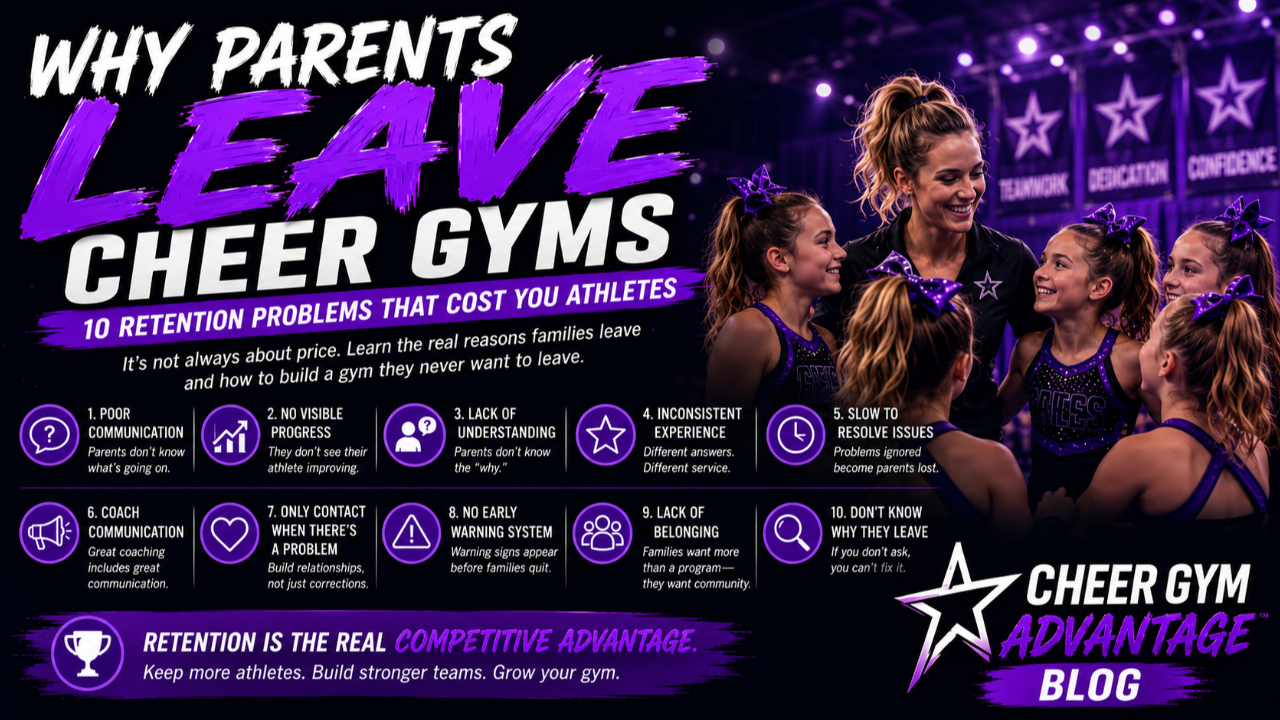
Why Parents Leave Cheer Gyms: 10 Retention Problems That Cost You Athletes
Getting a new athlete through your doors takes work.
You spend money on advertising. You post on social media. You answer inquiries. You schedule trials. Your coaches evaluate athletes. Your staff follows up with parents.
Finally, the family enrolls.
Then six months later, they're gone.
For many All Star Cheer gyms, the biggest growth opportunity isn't necessarily generating more leads.
It's keeping more of the athletes they already worked so hard to acquire.
Consider the math.
If your gym starts the year with 200 athletes and loses 50 over the course of the year, you need 50 new athletes just to get back to where you started.
Generate 60 new athletes and you technically grew—but only by 10.
Now imagine you improved retention enough to lose only 25 athletes.
Those same 60 enrollments would produce dramatically different growth.
That's why retention shouldn't be treated as simply a customer service metric.
Retention is a growth strategy.
And if families are leaving your gym, understanding why may be one of the most profitable things you can do.
Here are 10 common retention problems All Star Cheer gym owners should watch closely.
1. Parents Don't Know What's Going On
One of the fastest ways to create dissatisfied customers is uncertainty.
Parents shouldn't constantly wonder:
When is practice?
Did the schedule change?
What time should we arrive at competition?
Where do we meet?
When is payment due?
What does my athlete need to bring?
Who should I contact?
When will team information be released?
When parents repeatedly have to hunt for information, communication becomes part of the problem.
The issue isn't necessarily that your gym doesn't communicate.
You may actually communicate too much through too many different channels.
One coach sends a text.
Another posts in an app.
The front desk sends an email.
Someone posts on social media.
Then an important announcement gets buried.
Create a Communication System
Define exactly:
What gets communicated.
Who communicates it.
Which channel is used.
When it is sent.
Who handles questions.
When management becomes involved.
Consistency creates confidence.
And confidence builds trust.
2. Parents Don't See Their Athlete Progressing
Coaches may recognize an athlete's development immediately.
Parents often don't.
They may not understand that improved body positioning, stronger technique, better timing, increased confidence, or greater consistency represents meaningful progress.
They may simply see:
"My daughter still doesn't have her back handspring."
If families don't recognize progress, they may eventually question the value they're receiving.
Make Progress Visible
Create ways to communicate athlete development.
That might include:
Skill tracking.
Progress evaluations.
Athlete reviews.
Goal-setting.
Coach feedback.
Milestone recognition.
Progress reports.
Parent conferences when appropriate.
Celebrating development shouldn't only happen when an athlete gets a new skill.
Improvement happens in dozens of smaller ways.
Help families see the journey, not simply the destination.
3. Parents Don't Understand the "Why"
This happens frequently in competitive youth sports.
A coach makes a decision based on safety, routine construction, athlete readiness, team needs, or competitive strategy.
The parent sees only the outcome.
Why isn't my athlete flying?
Why was she moved?
Why isn't he throwing that skill?
Why did the routine change?
Why isn't my child on the team I expected?
When families don't understand the reasoning behind decisions, they often create their own explanation.
And that explanation may be wrong.
Communication Doesn't Mean Negotiation
Your coaches shouldn't have to justify every coaching decision.
But your organization should communicate important decisions professionally and appropriately.
Parents don't necessarily need to agree with every decision.
They do need confidence that decisions are being made thoughtfully, consistently, and in the athlete's best interest.
4. The Customer Experience Changes Depending on Who Is Working
One employee is warm and helpful.
Another barely acknowledges parents walking through the door.
One coach responds professionally.
Another sends a two-word text.
One front desk employee knows exactly how to answer a billing question.
Another says:
"You'll have to ask the owner."
Families don't separate these interactions into departments.
To them, all of it is your gym.
Your brand isn't only your logo, colors, uniforms, and social media.
Your brand is also:
How the phone gets answered.
How quickly emails receive responses.
How employees greet athletes.
How coaches speak to parents.
How problems are resolved.
How your facility looks.
How organized competitions feel.
How billing issues are handled.
Every interaction either strengthens or weakens confidence in your organization.
5. Problems Aren't Resolved Quickly Enough
Most long-term customers will eventually experience a problem.
That's normal.
The problem itself isn't always what causes someone to leave.
Often, it's how the organization responds.
Imagine a parent raises a concern on Monday.
Nobody responds.
They follow up Wednesday.
Someone says they'll look into it.
Friday arrives.
Still nothing.
Now the original problem isn't the only problem.
The parent also feels ignored.
Establish Response-Time Standards
Your organization should define expectations for different communication types.
Routine questions may have one response standard.
Billing concerns another.
Formal complaints another.
Safety or athlete-protection concerns require immediate escalation.
Your staff should know:
Who owns the issue?
When must they respond?
When should it be escalated?
Who closes the loop with the parent?
Sometimes excellent customer service isn't solving the problem instantly.
It's making sure the customer knows someone owns it.
6. Your Coaches Are Technically Good but Poor Communicators
A coach can understand cheerleading extremely well and still struggle with customer experience.
Remember:
Your athletes experience the coach directly.
Your parents experience the coach differently.
Parents notice professionalism.
Tone.
Body language.
Organization.
Communication.
Consistency.
How athletes are treated.
How mistakes are handled.
How feedback is delivered.
Whether the coach appears prepared.
Whether every athlete receives attention.
Technical knowledge is only part of coaching inside a customer-facing youth sports organization.
Coach Development Should Include More Than Cheer Skills
Train coaches on:
Professional communication.
Parent boundaries.
Athlete communication.
Conflict management.
Practice organization.
Leadership.
Customer experience.
Documentation.
Escalation procedures.
Your coaches aren't simply delivering practices.
They're delivering a significant portion of the product families are paying your business for.
7. Your Gym Only Pays Attention to Families When Something Goes Wrong
Some gyms have almost no structured interaction with parents unless:
A payment fails.
An athlete misses practice.
A problem occurs.
A form is missing.
There's a competition issue.
The parent complains.
Think about that experience.
Most direct communication from the organization becomes associated with problems.
That's a missed opportunity.
Create positive touchpoints throughout the season.
Recognize athlete milestones.
Celebrate progress.
Ask for feedback.
Share wins.
Highlight teams.
Thank families.
Communicate what's happening inside the program.
Make parents feel connected to the organization.
Don't wait until someone is unhappy to start communicating with them.
8. You Don't Identify At-Risk Athletes Early Enough
Most cancellations probably aren't truly sudden.
There were often warning signs.
Attendance declined.
The athlete became disengaged.
The parent stopped participating.
Payments became inconsistent.
A concern was never fully resolved.
The athlete stopped taking additional classes.
Communication decreased.
The family started asking unusual questions about contracts or cancellation policies.
Individually, these may mean nothing.
Together, they may indicate risk.
Build an Early-Warning System
Your management team should periodically review athletes who may be at risk of leaving.
Consider signals such as:
Declining attendance.
Repeated complaints.
Unresolved customer service issues.
Payment problems.
Low athlete engagement.
Coach concerns.
Injury-related absence.
Team dissatisfaction.
Repeated schedule conflicts.
Then intervene before the cancellation request arrives.
Retention is much easier when you're proactive.
9. Families Don't Feel Like They Belong
Cheerleading has something many businesses would love to have:
Community.
Athletes spend enormous amounts of time together.
Parents see one another at practices and competitions.
Teams experience wins, losses, travel, pressure, excitement, and milestones together.
That creates the potential for deep loyalty.
But belonging doesn't happen automatically.
New families can feel like outsiders.
Parents may struggle to understand cheer terminology or competition culture.
Athletes joining established groups may feel intimidated.
A family that never develops an emotional connection to the gym has fewer reasons to stay when something becomes inconvenient.
Build Community Intentionally
Consider:
New-family welcomes.
Parent orientation.
Team events.
Recognition programs.
Gym traditions.
Community service.
Athlete celebrations.
Family events.
Mentorship between experienced and new families.
Season kickoffs.
End-of-season celebrations.
You're not simply creating customers.
You're creating a community people want to remain part of.
10. You Don't Actually Know Why Families Leave
This may be the biggest retention problem.
An athlete leaves.
Someone says:
"They couldn't afford it."
Or:
"They wanted something less competitive."
Or:
"They went to another gym."
But did anyone actually ask?
Without accurate information, management starts solving problems that may not exist while ignoring problems that do.
Track Attrition Reasons
Every cancellation should be categorized.
Possible reasons might include:
Financial.
Schedule conflict.
Relocation.
Athlete lost interest.
Other sports.
Coaching concern.
Team placement.
Competitive experience.
Customer service.
Injury.
Program expectations.
Switched to competitor.
Unknown.
Then review the data.
If one athlete leaves because of coaching, that's an incident.
If 15 athletes leave citing coaching, that's a pattern.
If multiple families leave because of scheduling, that's operational intelligence.
If families consistently cite price, determine whether the actual issue is affordability—or whether they don't perceive enough value to justify the price.
Data turns cancellations into information you can use.
The Retention Math Every Cheer Gym Owner Should Understand
Let's use a simplified example.
Suppose your gym has:
250 athletes
and annual retention of:
75%
That means approximately 62 athletes need to be replaced just to maintain roughly the same enrollment level.
Now improve retention to:
85%
Approximately 37 athletes would need replacing.
That's roughly 25 fewer replacement enrollments required before your marketing creates net growth.
Now consider everything required to acquire those 25 athletes:
Advertising.
Lead generation.
Staff follow-up.
Trials.
Evaluations.
Sales conversations.
Onboarding.
Administrative work.
Improving retention can reduce pressure across the entire customer acquisition system.
That's why acquisition and retention should never be managed as completely separate functions.
The easiest athlete to enroll may be the one who is already enrolled.
Retention Starts Before the Athlete Enrolls
There's another important point.
Retention doesn't begin when someone considers quitting.
It begins during marketing and sales.
If your marketing creates unrealistic expectations, retention suffers.
If your sales process promises something operations cannot deliver, retention suffers.
If team placement isn't communicated clearly, retention suffers.
If onboarding doesn't prepare families for the realities of competitive cheer, retention suffers.
The entire journey matters:
Marketing → Inquiry → Trial → Enrollment → Onboarding → Participation → Progress → Communication → Competition → Renewal
Each stage influences whether a family eventually says:
"We're coming back next season."
Measure Your Athlete Retention Rate
At minimum, gym leadership should know its retention rate.
A simple version is:
Athlete Retention Rate
Athletes Remaining ÷ Athletes Eligible to Remain × 100
But don't stop with one organization-wide number.
Consider analyzing retention by:
Team.
Age group.
Program.
Coach.
Season.
Tenure.
Competitive level.
New versus returning athletes.
Acquisition source.
Patterns become easier to identify when you segment the data.
You may discover your overall retention looks acceptable while one specific program has a serious problem.
Don't Confuse Retention With Keeping Everyone
Not every athlete should remain forever.
Families move.
Interests change.
Schedules change.
Financial circumstances change.
Athletes graduate.
Sometimes your program simply isn't the right fit.
The goal isn't 100% retention at any cost.
And retention should never mean tolerating inappropriate behavior, compromising standards, making unsafe coaching decisions, or changing team placements simply to avoid upsetting someone.
The goal is to prevent avoidable attrition.
You want families leaving because their circumstances changed—not because your organization repeatedly failed to communicate, manage expectations, resolve concerns, or deliver a professional experience.
Build a Gym Families Want to Stay With
The strongest retention strategy isn't a clever renewal promotion.
It's creating an organization that families don't want to leave.
That requires:
Great coaching.
Visible athlete progress.
Professional communication.
Consistent operations.
Strong leadership.
Clear expectations.
Responsive customer service.
Community.
Trust.
When those elements work together, retention becomes a natural outcome of the experience.
Turn Customer Experience Into a Competitive Advantage
Cheer Gym Advantage™ is designed to help All Star Cheer gym owners build the systems behind a stronger, more scalable organization.
Inside The Advantage Vault™, you'll find resources designed to improve the areas that directly influence the athlete and parent experience, including:
Parent Communication
Parent Communication Forms
Front Desk Procedures
Practice Operations Checklists
Team Evaluation & Athlete Placement
Staff Positions & Accountability
30-Day Employee Onboarding
Management Operating Rhythm
Executive KPI Scorecard
…and an expanding collection of tools, systems, checklists, templates, and strategies.
Because generating new athletes is only one side of growth.
The gyms that build long-term momentum learn how to attract great families—and give them compelling reasons to stay.
